Every Missed Call Is a Missed Job: How AI Voice Agents Work for UK Service Businesses
There is a number that should bother every service business owner in the UK.
£31.6 billion.
That is the amount UK businesses lose every
year by failing to answer the phone. Not through bad service, not through poor pricing, not through weak marketing, just by not picking up.
And here is what makes it worse: 85% of callers who go unanswered never try again. Sixty-two percent ring a competitor within the same minute.
You do not lose that customer to a better offer. You lose them to the first person who answers.
David Morgan, founder of Snowdon Trails in Conwy, put it plainly when we spoke to him: "We were burning two days a week on bookings and rescheduling. After RevenueLadder set up the voice agent and tied it into our calendar, both of us got our Tuesdays back. That alone paid the retainer for the year."
This is what AI voice agents actually fix. Not a theoretical problem, a real one, happening to real businesses, every single day.
The real cost of a missed call (not what you think)
Most business owners know missed calls are bad. Few have actually worked out what they cost.
Take a plumber in North Wales. Average job value: £180. Average calls per day: twelve. On a busy Tuesday, on-site all morning, van in the afternoon, he misses eight of them. Not all eight are new enquiries. But even if half are, that is four potential jobs he will never hear about again.
Four jobs at £180. Every Tuesday. Fifty weeks a year.
That is £72,000 in lost revenue from one afternoon of missed calls per week.
The number gets worse when you factor in after-hours calls. Most service businesses see 30–40% of their inbound enquiries arrive outside working hours, evenings, weekends, bank holidays. The precise moments when no one is there to answer.
An emergency plumbing call at 11pm on a Sunday night is worth £350 minimum. The person calling is not shopping around. They are panicking. The first voice they hear gets the job.
Right now, that voice belongs to your competitor.
What an AI voice agent actually is (and what it is not)
Let us clear something up immediately, because the name puts people off.
An AI voice agent is not a phone menu. It is not "press 1 for bookings, press 2 for enquiries." Anyone who has navigated one of those in the last decade understands why that comparison matters, they are frustrating, impersonal, and designed for the business, not the customer.
It is also not voicemail. And it is not an offshore call centre reading from a script.
An AI voice agent is a conversational system that speaks naturally, understands what the caller is actually saying, responds in context, and takes action, booking an appointment, answering a question, escalating to a human when the situation calls for it.
The caller phones your number. The agent answers within two rings. It greets them by your business name, in a natural voice, and asks how it can help. From that point, the conversation flows like a normal phone call.
It is not perfect. No technology is. But it handles the vast majority of inbound call, the bookings, the availability checks, the pricing questions, the reschedules, without any human involvement. And it does it at 11pm on a Sunday the same way it does it at 10am on a Wednesday.
How it works, end to end
Here is the full flow of a call handled by a RevenueLadder voice agent:
1. The customer calls your number.
The AI answers within two rings, greets them by your business name, and opens the conversation naturally.
2. The agent understands the request.
Using natural language processing, it works out what the caller needs, a booking, a price, an availability check, a specific question about your service.
3. It qualifies the caller.
For trades and service businesses, this often means gathering the basics: what is the job, where is the property, what is the urgency? For hospitality, it means party size, date, time, any dietary requirements.
4. It checks your calendar and offers slots.
Integrated with your booking system, it sees your real availability in real time and offers options. The caller picks a slot. The agent confirms it.
5. A confirmation goes to both parties.
The customer gets a text or email confirmation. You get a notification, a summary of who called, what they booked, and any notes worth knowing.
6. If it cannot help, it escalates cleanly.
Complex situations, upset customers, unusual requests, the agent recognises when a human is needed and hands off gracefully, with a summary of the conversation so far. Nobody has to repeat themselves.
The whole process takes about ninety seconds for a standard booking. That is faster than most humans on a busy day.
Who it works best for
AI voice agents are particularly effective for any business where the phone is the primary booking channel and where staff availability is the bottleneck.
Restaurants and cafés
Peak service means nobody can leave the floor to answer the phone. Online booking captures some demand, but a meaningful proportion of customers, especially older demographics, still prefer to call. Every unanswered ring during a Saturday lunch service is a table you will not fill.
Eleri Williams, co-founder of Aber Coffee Co. in Aberystwyth, came to RevenueLadder with exactly this problem. After we built and integrated their voice agent, bookings increased fourfold. The agent handles reservations, dietary enquiries, and event bookings around the clock, including the Sunday evening calls that used to go unanswered every week.
Taxi and private hire
Dispatch is the operational heartbeat of any taxi firm, and it never stops. Calls at 3am, calls during school runs, calls during the busiest hours when every driver is already out. A human dispatcher is expensive, requires breaks, and goes home.
Arrow Taxi in Bangor came to us needing exactly this solved. We built a voice agent that takes bookings, confirms fares, handles rescheduling, and integrates directly with their dispatch system. The human operators now focus on exceptions, driver issues, complex routes, complaints, not routine bookings.
Plumbers, electricians, and trades
This is arguably the highest-value use case of all. Emergency calls are worth the most, arrive at the worst times, and go to whoever answers first. A sole trader on a job physically cannot answer the phone. Every unanswered emergency call is a guaranteed lost job.
Beyond emergencies, most tradespeople lose a significant volume of quote requests simply because they are busy when the call comes in, and the customer has already rung someone else by the time they call back.
Hotels, B&Bs, and holiday lets
Reservation enquiries are time-sensitive. A potential guest calling about a bank holiday weekend will not wait twenty-four hours for a callback, they will book somewhere else.
The after-hours problem is particularly acute here. Most enquiries about special occasions arrive in the evenings, when the owner has finished for the day. An AI agent available at 10pm captures those bookings in real time.
Salons, clinics, and appointment-based businesses
Staff are with clients. They cannot step out to take a call. Missed rebook calls, customers trying to make their next appointment while they are still happy from the last one, are direct, recurring revenue walking out the door.
A voice agent handles the incoming calls, checks the schedule, confirms the booking, and sends a reminder. The therapist, stylist, or practitioner never has to break a session to answer the phone.
The honest cost comparison
Here is what your options actually cost, in real terms.
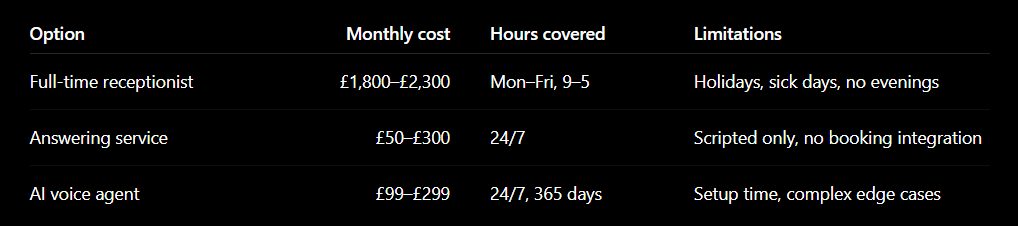
The answering service comparison is worth dwelling on. Traditional answering services, and there are good UK ones, are better than nothing, but they have a ceiling. They take a message. They cannot check your calendar, make a booking, answer a specific question about your services, or integrate with your CRM. They are a human reading a script, and your customers can feel it.
An AI voice agent costs roughly the same, covers every hour of the year, and actually closes the booking rather than just recording the enquiry.
Our voice agents at RevenueLadder have maintained 97% uptime over the last twelve months across all active clients. The 3% covers maintenance windows and the occasional edge case that needed a human in the loop.
"Will my customers hate it?" - the honest answer
This is the question we get asked most, and it deserves a straight answer.
Some customers will notice they are speaking to an AI. Most will not, especially in the first thirty seconds of a booking call, where the interaction is structured and the agent sounds natural. The ones who notice and object will say so, and the agent will escalate to a human immediately.
What customers actually hate is waiting. They hate ringing three times and getting voicemail. They hate leaving a message and not hearing back until the next morning. They hate phoning at 7pm and being told the office is closed.
An agent that answers in two rings and confirms a booking in ninety seconds is a better experience than being ignored, regardless of whether it is human or AI.
That said, there are situations where a human is the right answer. Complaints, bereavement, complex or emotional conversations, situations requiring genuine judgement, these are not for an AI agent, and a well-built system will recognise and escalate them. The technology is a first line, not a replacement for human judgement.
Welsh and UK-specific considerations
A few practical points that most guides on this topic skip over.
UK GDPR compliance. Call recordings and transcripts are personal data under the Data Protection Act 2018. Your voice agent setup needs to notify callers that the call may be recorded and processed by AI, and your data processor agreement with the provider needs to be in place. This is not optional. RevenueLadder builds this compliance into every deployment.
The 2027 PSTN switch-off. BT and Openreach are retiring the UK's analogue telephone network in 2027. Any business still on a traditional landline will need to migrate to a VoIP or digital system regardless. An AI voice agent runs on digital infrastructure by default, deploying one now puts you ahead of a switch you will have to make anyway.
Welsh-language calls. For businesses in North and West Wales, a meaningful percentage of customers prefer to open a conversation in Welsh. We have published a separate piece on how we approach Welsh-English voice agent training, it is a genuinely different challenge that most providers have not thought about, and one where local knowledge matters.
Welsh Government AI funding. Wales currently has one of the lower SME AI adoption rates in the UK, around 7% compared to 10% across England. The Welsh Government has an active AI adoption programme with funding available to qualifying SMEs. If you are based in Wales and considering this investment, it is worth a conversation before you sign anything.
How to get started
Three practical steps, in order.
First, audit your missed call rate. Most business owners do not actually know this number. Check your phone records or call data for the last month. How many inbound calls received no answer? This is your baseline. If you cannot measure the problem, you cannot measure the fix.
Second, map your booking flow. An AI voice agent is only as good as the system behind it. Before deployment, you need to know: what does a standard booking call involve? What information do you need from the caller? Where does that information go? What happens next? A voice agent built on a clear process works well. One built on a chaotic one amplifies the chaos.
Third, start with one use case. Do not try to automate everything at once. Pick the highest-volume, most repetitive call type, usually standard bookings, and deploy the agent there first. Expand once you have seen how it handles real calls.
At RevenueLadder, we run a 30-minute strategy call before any deployment. We walk your current setup, identify where calls are being lost, and send you a written plan within 48 hours. No obligation. No hard pitch. If the numbers do not add up for your business, we will tell you.
Frequently asked questions
Do AI voice agents actually work for small businesses?
Yes, particularly for businesses where bookings and standard enquiries make up the majority of inbound calls. The technology has matured significantly in the last two years. The main requirement is a clear, mappable call flow.
How much does an AI receptionist cost in the UK?
Typically £99–£299 per month depending on call volume and integration complexity. Setup fees vary by provider. RevenueLadder charges a one-off setup fee and a monthly retainer that includes monitoring and ongoing improvements.
Is an AI answering service GDPR compliant?
It can be, but compliance is not automatic, it depends on how the system is built and who processes the data. You need a caller notification, a data processing agreement with your provider, and UK-based or adequacy-covered data storage. We build these requirements into every deployment.
Can AI take phone bookings?
Yes. This is the most common use case. The agent checks your live calendar, offers available slots, confirms the booking with the caller, and sends confirmation to both parties.
What happens when the AI cannot answer a question?
A well-built agent recognises the limit of its knowledge and escalates to a human, either by transferring the call live or by taking a message with a summary for callback. Callers are not left in a dead end.
Will my customers know they are talking to AI?
Some will, some will not. The agent is natural-sounding, not robotic. Customers who ask directly are told they are speaking with an automated system. In our experience, the customers who object are a small minority, and most of them prefer a fast, helpful AI to three rings and a voicemail.
The bottom line
Every service business in the UK is losing revenue to unanswered calls. Not because of bad service, not because of weak products, because no one was there to pick up.
An AI voice agent does not replace your team. It covers the hours your team cannot. It handles the calls your team is too busy to take. It captures the bookings that currently go to whoever answers faster.
The technology is no longer experimental. It is running live across restaurants, taxi firms, trades businesses, and hospitality providers across Wales and the UK right now, including on the RevenueLadder platform.
The calls are coming in. The question is whether you are ready to answer them.
Ready to grow?
If you want to see what it would look like for your business, book a 30-minute strategy call. We will walk your current setup, identify where calls are being lost, and give you a written plan. No obligation.
Book a callRevenueLadder is a Welsh automation agency based in Bangor, North Wales. We build voice agents, web infrastructure, and automation systems for UK small businesses.
Leave a comment